

42@rubiconsedge.com | Spokane, Washington, USA | +1 509-425-3904
When Alignment Breaks
Down, Performance Follows
In small organizations and professional firms, the greatest risks rarely come from lack of expertise. They emerge when values drift under pressure, communication fractures at critical moments, and high-performing leaders retreat into silence or isolation.
Most organizations do not fail because of poor strategy or weak talent.
They struggle because the way decisions are actually made no longer matches what the organization says it stands for.
Under stress, even highly capable teams revert to predictable patterns. Autonomy hardens into silos. Compliance replaces judgment. Conversations that once felt direct become cautious, coded, or absent altogether.
These are not interpersonal problems. They are signals of systemic misalignment.
My work helps organizations identify where alignment has broken down, understand why it happens under pressure, and restore coherence across leadership, values, and communication before the cost becomes irreversible.
What’s Actually Happening Under Pressure
When pressure rises,
alignment collapses in predictable ways.
What looks like conflict, delay, or disengagement is usually something else entirely.
Most organizational breakdowns are misdiagnosed.
Missed deadlines get blamed on execution.
Internal friction gets labeled a “people problem.”
Silence in meetings gets mistaken for agreement.
But under sustained pressure, teams do not rise to stated values. They revert to their default operating systems.
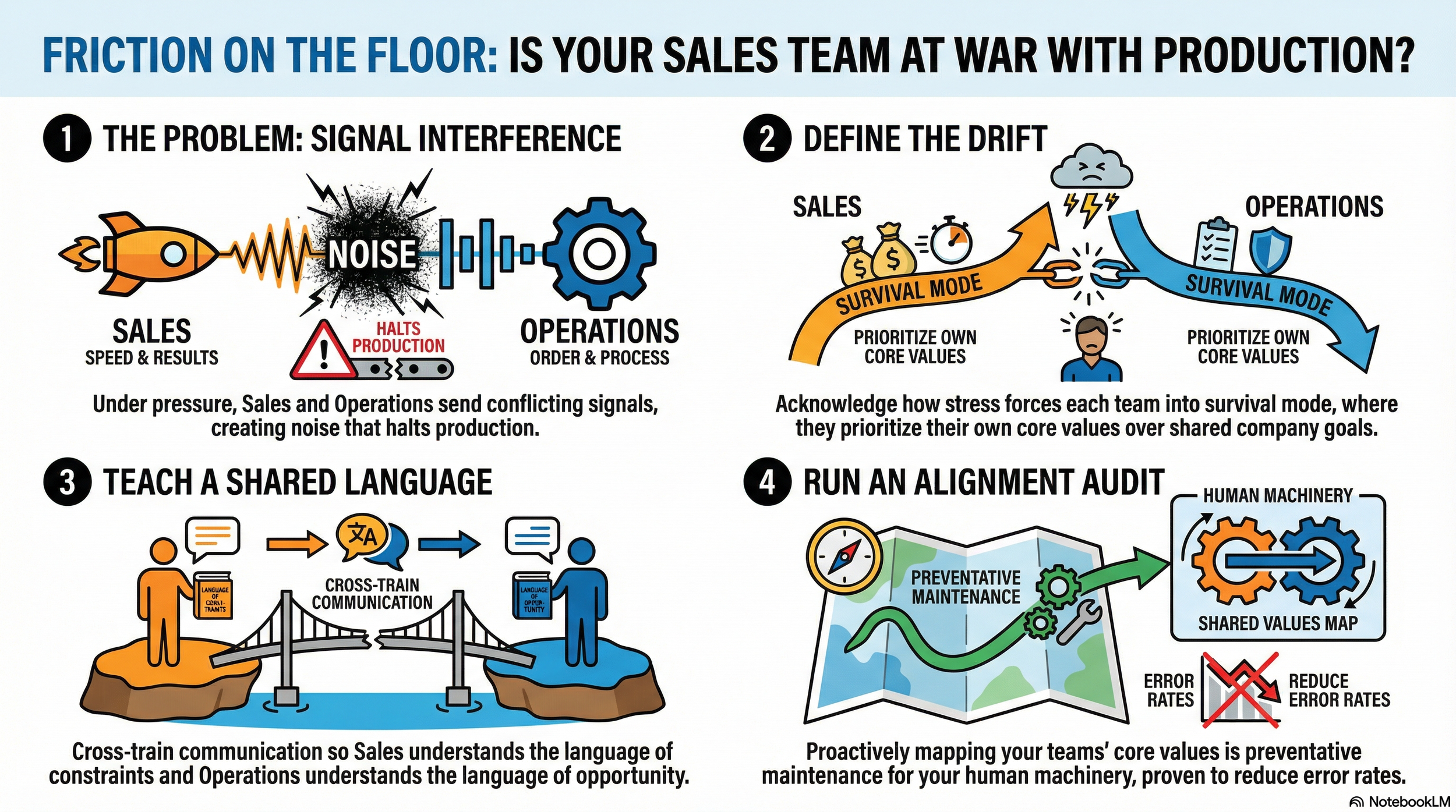
Sales teams optimize for speed, opportunity, and momentum.
Operations teams optimize for order, process, and constraint.
Leadership teams often assume those differences will “work themselves out.”
They do not.
Under stress, these competing priorities create signal interference. Messages cancel each other out. Decisions stall. Trust erodes quietly. Productivity drops not because people are incapable, but because they are speaking fundamentally different languages under pressure.
Under pressure, different parts of the organization begin sending conflicting signals, each optimized for what they value most.
What matters most is this:
This is not a supply chain issue.
It is not a motivation issue.
It is not a personality issue.
It is a values and communication alignment issue, triggered by stress.
When pressure rises, individuals and teams retreat to what feels safest and most familiar. Without a shared framework for values, language, and decision-making under stress, even high-performing professionals begin optimizing for their own survival rather than collective outcomes.
Left unaddressed, this drift becomes systemic.
The question is not whether this is happening. The question is whether it is being measured, named, and addressed
Misalignment Is a Liability Before It’s a Morale Problem
Most organizations do not fail because their people lack skill or commitment.
They fail because under pressure, shared values stop translating into shared behavior.
When that happens, the organization begins operating on assumptions rather than alignment:
Teams retreat into silos.
Decision-making slows or fractures.
Communication becomes cautious, coded, or performative.
Errors increase, even among high performers.
What looks like a “communication issue” is often something more fundamental:
values drift under stress.
When values are not explicitly mapped to behavior, people default to what feels safest to them personally. Under pressure, those defaults diverge. The organization loses coherence precisely when it needs it most.
I have seen this pattern repeatedly in professional environments where the cost of getting it wrong is high.
With over three decades working in transactional law environments as a senior paralegal, I supported attorneys and leadership teams through moments where misalignment did not just strain relationships. It introduced risk: missed details, fractured trust, delayed decisions, and created avoidable downstream consequences.
The issue was rarely competence.
It was almost always unexamined assumptions operating under pressure.
This is why alignment work cannot stay abstract.
Values must be translated into observable behavior, shared language, and decision protocols that hold when the pressure is on.
That translation is the difference between an organization that reacts and one that responds.
Alignment Fails in Predictable Ways
Misalignment Is Not Random.
It Follows a Pattern.
When organizations experience breakdown under pressure, it rarely happens all at once.
It follows a predictable sequence.
What changes is not the people.
What changes is how they operate when stress enters the system.
Across professional firms, small organizations, and teams, the same pattern appears:
The Alignment Drift Pattern
1. Competing Operating Priorities Emerge
Different roles optimize for different outcomes. Speed versus precision. Opportunity versus
constraint. Autonomy versus protocol.
Individually, these priorities make sense.
Collectively, they begin to interfere with one another.
2. Stress Pushes Teams Into Survival Mode
Under sustained pressure, people stop referencing shared values
and start protecting what feels most immediately at risk.
Decision-making narrows.
Communication becomes guarded.
Collaboration gives way to control or withdrawal.
This is not dysfunction.
It is a predictable human response to unresolved tension.
3. Language Loses Shared Meaning
Teams use the same words but mean different things by them.
“Urgent.”
“Done.”
“Quality.”
“Responsibility.”
Without shared definitions, communication creates noise instead of clarity. People talk
past one another while believing they are aligned.
4. Values Become Symbolic Rather Than Operational
Stated values remain visible, but they no longer guide behavior under pressure.
At this stage, leaders often feel confused. The values are clear. The talent is strong. And yet performance degrades exactly when it matters most.
This is not a culture problem.
It is an alignment problem across strategy, values, and human capacity under stress.
Alignment can be restored. But it cannot be imposed, encouraged, or trained into existence.
It must be diagnosed, translated, and integrated in ways that hold when the system is under pressure.

Alignment is an organizational responsibility, not a moral one.
People behave rationally within the systems they are given.
Stress reveals design flaws; it does not create them.
Alignment Is Restored Through Deliberate, Structured Work
Restoring alignment requires more than good intentions or communication training.
It requires a disciplined approach that makes invisible dynamics visible and translates values into decisions that hold under pressure.
My work with organizations is grounded in an Alignment Framework designed to identify and resolve the sources of friction that undermine trust, clarity, and performance, especially when stakes are high. Rather than focusing on individual behavior in isolation, the framework examines how strategy, values, and capacity interact across the organization as a whole.
This makes it possible to address misalignment at its source, before it hardens into burnout, conflict, or attrition.
The Alignment Framework
At its core, the Alignment Framework addresses three interdependent dimensions
Strategy
How the Organization Works
Values
Why the Organization Works
Capacity
What Fuels the Work
How work is structured, decisions are made, and authority flows across the organization.
This includes examining where decision-making slows, fragments, or concentrates under pressure, and whether existing structures support clarity or create friction.
What actually drives behavior when the stakes are high.
This work goes beyond stated values to examine how priorities shift under stress, how values are interpreted differently across roles, and where drift has quietly become normalized.
Whether the organization has the human and energetic resources to sustain what it is asking of its people.
This includes identifying hidden strain, misallocated effort, and structural pressures that lead to burnout or disengagement, even among committed professionals.
Misalignment in any one of these areas creates friction in the others. Sustainable change requires addressing all three together.
Applied Alignment Engagements
Alignment work is delivered through Applied Alignment Engagements: custom-scoped, time-bounded collaborations designed around a specific friction point identified within the organization.
These engagements may include:
Leadership or partner alignment sessions
Values-to-decision mapping
Communication pattern analysis under pressure
Role clarity and authority boundary work
Capacity and sustainability recalibration
The focus is always practical. The goal is not cultural abstraction, but restored coherence where it matters most.
Alignment is not imposed.
It is built through shared language, clear decisions, and structures that hold when pressure rises.
Perspective and Scope
This framework is informed by decades of work inside transactional legal and professional service environments, where I saw firsthand how values drift, communication breakdowns, and energy depletion create risk long before they appear on paper.
My role is not to replace legal, HR, or compliance functions, but to work upstream of them, where alignment can still be restored rather than enforced.
The Alignment Framework can be applied in different ways, depending on the size, structure, and needs of the organization. What matters most is not the format, but that the work is matched to the actual source of friction, not just its symptoms
Clarity Comes Before Commitment
Alignment work begins with understanding, not intervention.
Before organizations commit to deeper engagement, it is essential to identify where misalignment is actually occurring, how it is showing up under pressure, and what is being quietly absorbed by leadership and staff. Without this clarity, even well-intentioned efforts risk addressing symptoms rather than causes.
For that reason, entry into alignment work follows a deliberate sequence designed to establish shared understanding before change is attempted.
Diagnostic Assessment
Executive Alignment & Vitality Index
Organizations begin with a structured diagnostic that examines three interdependent dimensions:
How the organization works
Strategy, structure and decision flow under pressureWhy it works the way it does
Values as they are interpreted and enacted when stakes are highWhether it has the capacity to sustain current demands
Human energy, load, and resilience across roles and systems.
The goal is not scoring.
The goal is to identify the primary friction point where misalignment is already costing the organization clarity, trust, or resilience.
Shared Language and Readiness
Aligned Leadership Lab
April 22–25, 2026
For organizations ready to deepen the work, the Leadership Lab provides a shared language for understanding alignment, communication breakdowns, and values drift under pressure.
This experience is designed to:
Normalize predictable stress responses
Reduce blame and defensiveness
Establish a common framework for decision-making and dialogue
It functions as a threshold moment, not a solution in itself. Its purpose is readiness, not resolution.
Applied Alignment Engagements
From there, organizations may enter into Applied Alignment Engagements tailored to their specific context, goals, and constraints.
These engagements are:
Time-bounded
Purpose-driven
Structured around real decisions and operational realities
They are designed to restore coherence where it has been lost and strengthen the organization’s ability to function under pressure.
Not every organization is ready for this work.
Those that are value clarity, accountability, and integrity over quick fixes.
From Instinct to Alignment Under Pressure
Most organizational interventions stop at awareness.
This work does not.
The Alignment Framework is designed to move organizations from diagnosis to durable change, particularly under pressure, when values are most likely to fracture and communication quietly collapses.
By the time leaders engage beyond the initial entry points such as assessments, whitepapers, or a masterclass, they are no longer asking “what’s wrong”. They are asking:
Why does misalignment keep resurfacing even after “fixes”?
Why do strong performers disengage when stakes rise?
Why do communication breakdowns repeat across teams, partners, or departments?
This is where deeper alignment work becomes necessary.
The Progression of Engagement
Organizations typically move through this work in stages, not all at once.
1. Diagnosis & Awareness
Executive Alignment & Vitality Index
Whitepapers and leadership briefings
Values & communication mapping
2. Shared Language & Insight
Values & Communication Masterclass (4-day intensive)
CE workshops for licensed professionals
Internal clarity around decision-making under stress
3. Embedded Alignment
Values-in-Action implementation
Communication recalibration at leadership and team levels
Cultural friction addressed before it becomes attrition or risk
4. Individual Leadership Support
One-on-one work for managing partners, executives, or key contributors
Personal alignment work that strengthens leadership capacity rather than bypassing it
Each stage stands on its own.
Each stage also prepares the ground for the next.
Optional Individual Work for Leaders
Some alignment issues cannot be solved at the group level alone.
For leaders carrying disproportionate pressure and unresolved internal conflicts, this often show up as:
decision paralysis
communication avoidance
reactivity under stress
values drift that feels personal, not organizational
In these cases, leaders may be referred into advanced one-on-one work using the Catalyst Method.
This work:
is never required
is never positioned as corrective
is always consent-based and confidential
Its purpose is to strengthen the internal alignment so external leadership can stabilize.
What This Is — and Is Not
This work is:
strategic, not performative
grounded, not ideological
respectful of professional, legal, and ethical boundaries
It is not therapy, not legal advice, and not culture theater.
My work is informed by decades inside transactional legal environments, where breakdowns in alignment appear long before they can be addressed by policy, contracts, or litigation. I do not practice law. I work upstream, helping organizations address the systemic breakdown under pressure that legal remedies cannot repair after the fact.
Next Steps
If your organization is experiencing friction that logic alone cannot resolve,
the next step is clarity.
Begin with the Executive Alignment & Vitality Index
Attend the upcoming Values & Communication Masterclass
Or begin with a conversation about where alignment is breaking down
This work meets organizations where they actually are — not where they wish they were.